
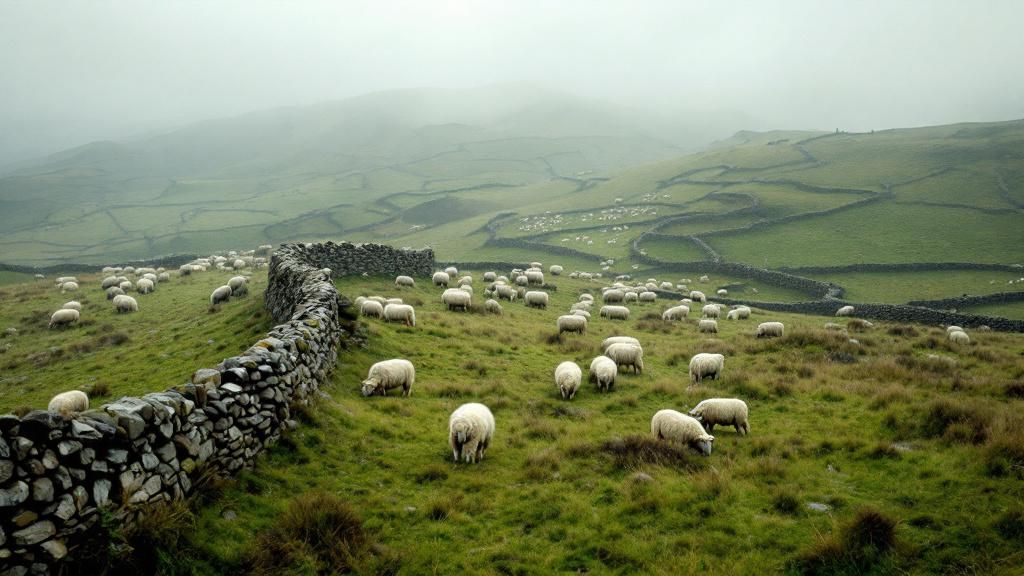
Britain’s livestock farming industry is experiencing its most dramatic transformation in generations, with flocks declining to levels not seen since the 1950s. The number of breeding ewes has plummeted to 14.7 million—the lowest figure in living memory—while the overall national flock has declined to 30.4 million sheep in 2025. The crisis is transforming rural landscapes across the country, from the Yorkshire Dales to upland farms nationwide, as producers struggle with soaring costs, dwindling subsidies, and fierce competition from overseas imports. Meanwhile, British appetite for lamb and mutton has plummeted, with household consumption dropping from 128 grams per person weekly in 1980 to just 23 grams today, forcing farmers to make difficult choices about the future of their operations and the countryside itself.
The Steep Decrease of Sheep on British Farms
The shift of Britain’s pastoral livestock landscape is strikingly shown by the experience of Hill Top Farm in Yorkshire’s Malhamdale, where the Heseltine family has farmed for four successive generations. Once home to over 800 lambing sheep at its peak, the 1,500-acre holding now maintains just 45 breeding females. Neil Heseltine describes the shift as a “complete turnaround” driven by financial pressure rather than choice, acknowledging that without these radical changes, the farm’s economic sustainability would have been severely compromised. His decision to shift away from sheep farming reflects a wider trend sweeping across Britain’s highland areas, where traditional pastoral farming faces mounting challenges.
The challenges facing sheep farmers are complex and growing. The average British farmer is now 60 years old, according to the National Farmers’ Union, and must handle soaring costs across energy, feed, and operational outlays. Meanwhile, state support have reduced markedly, straining extremely narrow profit margins. Perhaps most harmful are the latest trade arrangements with New Zealand and Australia, which abolished barriers and awarded these countries large shares for lamb shipments into the UK market. This influx of budget international imports has made it progressively harder for local farmers to maintain viable operations at current price points.
- Breeding ewes dropped to 14.7 million, lowest on record
- National flock decreased to 30.4 million sheep in 2025
- Lamb consumption fell from 128g to 23g weekly per person
- Trade deals with Australia and New Zealand boosted foreign competition
Moving Past Convention to Innovation
Sheep farming has been central to Britain’s rural identity and landscape for centuries, shaping the distinctive character of regions like the Yorkshire Dales. The iconic drystone walls that traverse these uplands were built specifically to contain livestock, while the rolling green hills owe their appearance to grazing cycles maintained by generations of shepherds. This heritage represents far more than agricultural tradition—it embodies a manner of living deeply connected to the land and communities. Yet this same landscape is now facing key questions about its future use and purpose as farming economics create hard choices.
The tension between protecting agricultural heritage and responding to contemporary conditions has become more pronounced. While many upland farmers keep sheep on their land, the financial rationale for extensive sheep production has fundamentally weakened. Some are considering whether certain upland areas might be better utilized for different uses, such as promoting natural habitat restoration or alternative land management approaches that could prove more economically sustainable. These conversations represent not nostalgia but practical thinking—farmers and policymakers grappling with how to sustain farming communities while recognizing that the sheep production of earlier times may no longer be viable.
Cost Pressures Forcing Farmers to Exit Sheep
The economic sustainability of sheep farming in Britain has deteriorated dramatically over recent decades, forcing farmers throughout the nation to make difficult decisions about their businesses. Neil Heseltine’s work with Hill Top Farm in the Yorkshire Dales illustrates this wider problem—his family cut their breeding herd from over 800 sheep to just 45 in spring, a shift driven by economic necessity rather than choice. As Heseltine notes, persisting in sheep farming purely out of sentimentality would have been economically ruinous. This change reflects a stark reality: the traditional shepherd’s life, never easy, has become progressively unsustainable as a primary income source for many rural families.
The structural challenges facing sheep farmers reach well beyond individual farm operational choices. The average British farmer is now 60 years old, according to the National Farmers’ Union, and many are functioning in an environment of substantially diminished income from farming support. Simultaneously, input costs have risen sharply, with prices for fuel, fodder, and other essentials rising substantially in recent years. These growing demands have coincided with declining demand for sheep meat and increased competition from more affordable imported lamb and mutton. For many farmers, the financial viability of sheep farming no longer works, despite their investment in the industry or their generational legacy.
| Year | Consumption per Person Weekly |
|---|---|
| 1980 | 128g |
| 2000 | 85g |
| 2010 | 45g |
| 2024 | 23g |
Rising Costs and Declining Revenue
British farmers encounter an unprecedented cost crisis that has significantly transformed the economics of sheep production. Fodder costs, fuel costs, and veterinary costs have all increased substantially, reducing already-thin margins. Simultaneously, farmers have experienced substantial cuts in financial support, which historically provided essential financial assistance. These dual pressures—mounting costs combined with shrinking government support—have made it extremely difficult for many operations to achieve profitability at current market prices for lamb and mutton.
The position has been exacerbated by newly negotiated trade deals that have saturated the British market with cheaper overseas lamb. The removal of trade barriers with Australia and New Zealand has given producers in those countries significant trading allowances into the UK, undercutting domestic prices. Farmers working in upland regions, where operating expenses are naturally higher due to difficult geographical conditions, have been particularly hard hit. Many are now questioning whether they can afford to continue sheep farming at all.
- Grant payments has fallen considerably since Brexit implementation
- Feed and fuel costs have increased dramatically over the past few years
- International competitors undercuts UK lamb pricing markedly
Shifting Consumer Preferences and International Market Competition
The fall in sheep farming demonstrates a fundamental shift in British dietary choices that has developed over many years. In 1980, the typical British family consumed 128 grams of sheep meat per person weekly—a figure that has fallen to just 23 grams in 2024. This substantial 82% drop in eating means fewer households are purchasing lamb and mutton for their kitchens, directly undermining the market that sustains upland farmers. The cultural and dietary changes that have caused this decline seem mostly permanent, requiring farmers to face a shrinking domestic demand for their main output.
Beyond evolving preferences, farmers now compete in an increasingly globalized market where they cannot match the prices of overseas producers. Australia and New Zealand benefit from lower production costs due to their climate and land availability, allowing them to undercut British farmers even before new trade deals. The mix of declining consumer demand and international price competition has created a perfect storm for the UK sheep farming industry. Many farmers argue they cannot adequately survive in this environment, forcing hard decisions about whether to keep raising sheep or shift toward alternative agricultural ventures.
Trade Agreements and Tariff Pressures
Britain’s post-Brexit trade agreements with Australia and New Zealand have fundamentally altered the market dynamics for UK sheep farming operations. These deals eliminated tariffs on overseas lamb and mutton products while providing both countries substantial export quotas into the UK market. The sharp rise of lower-priced imported lamb has weakened domestic prices, making it progressively harder for British farmers to maintain viable profits. Upland farmers, whose production costs are naturally higher due to challenging terrain and weather conditions, have been especially severely impacted by this fresh competitive challenge.
The influence of these commercial agreements reaches beyond short-term competitive pricing. They signal a movement toward UK agricultural direction toward unrestricted trade rather than protection of local farmers, a break with the state support framework that previously sustained sheep farming. Farmers argue they were not sufficiently involved or compensated for the move into this transformed trading landscape. Without tariff protection or financial support to compensate for the cost burden, many upland operations that have persisted for years now face an uncertain future in an increasingly competitive global market.
- Australia and New Zealand exports receive substantial allocations into British market
- Tariff elimination allows lower-cost foreign lamb to undermine British pricing
- Trade deals prioritize open market rivalry over domestic farmer protection
Government Financial Support Shift Away from Livestock
For decades, public funding constituted the economic foundation of British sheep operations, providing consistent revenue that mitigated the core obstacles of hill farming. However, the post-Brexit farming payment structure has substantially reformed these funding mechanisms, moving away from straightforward grants tied to livestock numbers. Farmers like Neil Heseltine now obtain markedly diminished earnings from these established payment schemes, forcing them to seek alternative revenue streams or stop raising sheep completely. This change has happened in tandem with increasing operational expenses in fuel, feed, and labor, creating a squeeze that many upland operations cannot sustain without major overhaul.
The transition in subsidy allocation indicates a broader policy reorientation toward environmental stewardship rather than agricultural commodity subsidies. Under the updated approach, farmers are more strongly encouraged to steward land for ecological preservation, wildlife habitat, and emissions reduction rather than maximize livestock output. While these conservation aims have merit, the implementation period has left many traditional sheep farmers caught between falling farm revenue and uncertain new payment schemes. Without proper financial assistance during this shift, numerous independent holdings risk shutting down or compulsory operational shifts, endangering both countryside economies and the traditional countryside that has defined Britain’s uplands for centuries.
Updated Green Priority for Support Schemes
The government’s restructured funding approach explicitly prioritizes sustainability goals over farming yields, paying producers for wildlife habitat improvement, tree planting, and species protection rather than animal husbandry. This conceptual change represents a substantial break from the historical approach of supporting food production through financial support. Farmers participating in innovative land-management initiatives receive payments based on land stewardship approaches that benefit ecosystems, water quality, and carbon sequestration. However, these revised compensation levels often do not equal the revenue previously received from animal farming support, putting numerous producers in worse financial positions despite compliance with ecological criteria.
The transition to environmentally-oriented subsidies has produced uncertainty for upland farmers used to output-focused support. Many are unclear about long-term payment levels under the new schemes and find it difficult to plan spending on environmental improvements without guaranteed financial returns. Younger farmers, already discouraged by falling sheep profitability, experience even deeper hesitation about entering an industry with such uncertain support mechanisms. The gap between environmental objectives ambitions and agricultural financial viability could increase rural depopulation and abandon upland areas to either rewilding or neglect, depending on how policy evolves.
- Subsidies now reward conservation and biodiversity over livestock production
- Environmental payments typically fall short than former agricultural support levels
- Uncertainty about long-term payment rates deters agricultural investment
- Young farmers growing hesitant to enter sheep farming under revised framework
Environmental Restoration Versus Agricultural Heritage
The decline of sheep farming has sparked a contested debate about the future of Britain’s upland landscapes. For hundreds of years, livestock farming has sculpted the unique identity of regions like the Yorkshire Dales, creating the rolling green hills and patchwork of drystone walls that characterize these areas. Yet ecological researchers argue that these same landscapes, molded through intensive livestock management, have damaged biodiversity and ecosystem health. The tension between maintaining farming traditions and recovering wild ecosystems has become increasingly difficult to reconcile, requiring policymakers and farmers to address fundamental questions about land use priorities and what constitutes sustainable management of Britain’s countryside.
Some conservationists view the reduction in sheep farming as an chance to rehabilitate upland ecosystems damaged by centuries of grazing pressure. They point to evidence that reducing livestock numbers allows native vegetation to regenerate, enhances water conditions, and provides space for wildlife species. However, farming communities worry that emphasizing ecological restoration over food output will eliminate rural incomes and convert productive land into undeveloped terrain. This philosophical clash reflects wider debates about whether uplands should mainly support agricultural output, conservation, or tourism, and who should benefit from decisions about land management in these economically marginal regions.
Evidence from Habitat Restoration Projects
Several rewilding projects across Britain have revealed measurable ecological benefits from decreasing or eliminating sheep grazing in upland areas. Projects in the Scottish Highlands, Lake District, and Peak District have recorded increased plant diversity, regeneration of native forests, and increases in bird and mammal populations following lower livestock intensity. These successes have secured government funding and wildlife charity support, encouraging expansion of rewilding programmes. However, farm operators often report substantial financial declines during transition periods, and resident groups voice objections about employment impacts and shifting scenic qualities.
The Knepp Estate in West Sussex provides one of Britain’s most renowned rewilding examples, showing that disused agricultural areas can support flourishing habitats and produce alternative income through tourism and conservation payments. Similar projects across elevated landscapes indicate viability for environmental recovery, yet rolling out such initiatives across the country requires considerable capital commitment and farmer cooperation. Success hinges upon bridging the gap between ecological objectives and rural economic viability, guaranteeing that nature recovery doesn’t simply neglect agricultural regions to poverty while restoring their ecosystems.
- Rewilding initiatives show greater species diversity and native vegetation recovery over a five-year period
- Farmers involved experience financial decline during transition to conservation management
- Tourism and conservation payments offer alternative income but seldom equal former farming income
Achieving Balance Between Agriculture and Conservation Efforts
The reduction of sheep farming offers an unexpected opportunity for conservation efforts across Britain’s uplands, yet the change remains disputed among stakeholders with conflicting views for land use in rural areas. Farmers argue that years of sheep grazing have created the unique terrain people cherish, from the Yorkshire Dales to the Scottish Borders. Conservation groups argue that decreasing animal numbers would allow native woodlands to regenerate and wildlife populations to bounce back, potentially creating new business prospects through green tourism and carbon sequestration payments. This fundamental disagreement reflects broader concerns about whose interests should shape Britain’s countryside and whether agricultural output or ecological restoration should come first.
Finding workable solutions requires stepping past polarized positions to build integrated approaches that support both rural livelihoods and conservation objectives. Some farmers are testing mixed-use models, combining reduced sheep numbers with environmental grazing agreements, tree planting, and diversified enterprises like agritourism. Government support through environmental stewardship schemes and transition funding could help additional landowners make comparable changes without facing financial ruin. Success depends on recognizing that farming communities have invaluable knowledge about landscape stewardship and deserve meaningful input into conservation decisions affecting their lands and livelihoods.
